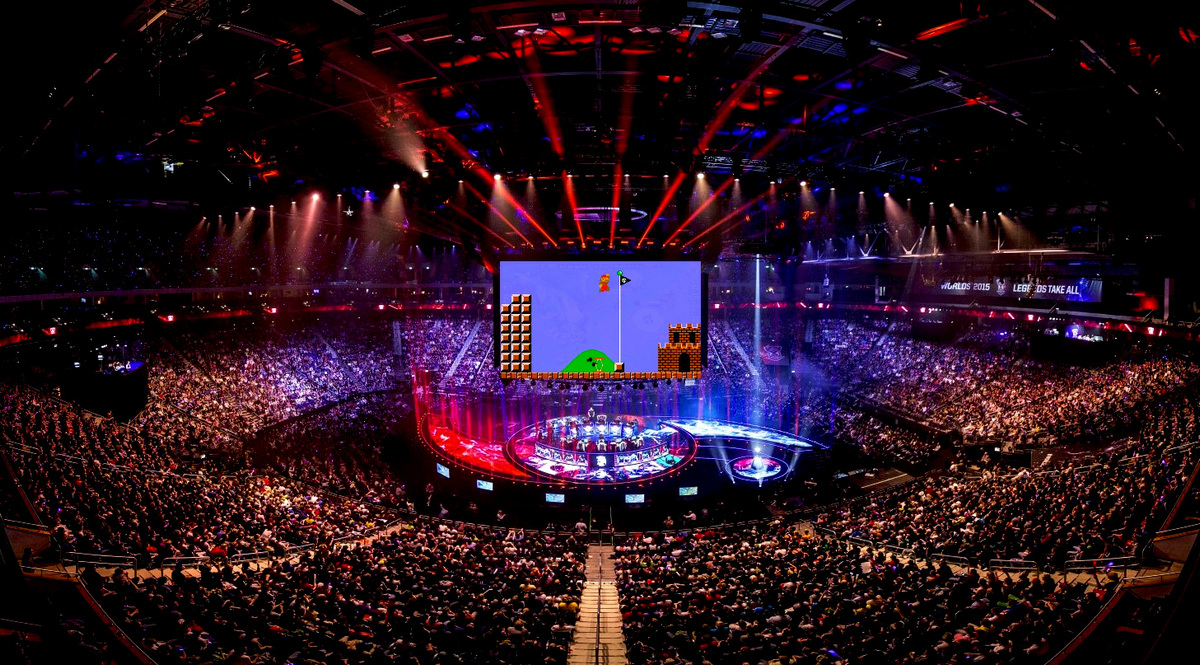
Imagine the scene in which a group of gamers get together to play their favorite video game. They join the tournament, compete with other players, fight for hours to win. Now imagine the same players, but at the stadium, whose game is closely watched by thousands of spectators. At the same time there is an online broadcast, joined by thousands more. Suddenly, these gamers from geeks transformed into valuable assets. This phenomenon is known as Cybersport or Electronic Sports, eSports.
Cybersport is now at its peak of popularity. More gamers and betters daily participate in e-sports events. Analytical company Newzoo
believes that in 2018, the global income from eSports will reach $ 905.6 million, the audience of e-sports events will grow to 380.2 million viewers.
Like traditional sports, cyber sports competitions have become major sporting events. For example, in 2017, the League of Legends Championship Finals took place at the Beijing Olympic Stadium, which seats up to 80,000 spectators. The finalists competed for a cash prize of almost 2.45 million dollars. Major tournaments are broadcast not only through online channels such as Twitch and YouTube, but also on major sports channels ESPN and Fox Sports.
Cybersport competitions
can be included in the list of the Olympic Games of 2024. A member of the International Olympic Committee (IOC), co-chairman of the application committee of Paris Tony Estanget (Tony Estanguet)
believes that eSports should be considered a full-fledged sport: this is necessary for the Olympic Games to remain relevant to new generations. Specific games have not yet been chosen, but in August 2017, President of the International Sports Committee Thomas Bach
shared his thoughts on this issue. In a
commentary for the South China Morning Post newspaper, he said that e-sports games with cruel or provocative content could not be part of the Olympics. According to Bach, many of the now popular computer games completely contradict the fundamental Olympic rules and values of sports.
In Asia, however, with eSports have already decided. The
Asian Games Committee (or the so-called Asian Games, held every four years among Asian athletes) has already
included eSports in the list of disciplines of the Asian Games of 2022. In the 2018 games in Jakarta (Indonesia), 45 countries participated, including Japan, China, South Korea, Singapore, and the United Arab Emirates.
ESports in Russia
The history of the Russian industry of eSports originates in the late 1990s. At the dawn of the post-Soviet era, Russian e-sports began to appear in computer clubs where the first gaming communities were formed. Counter Strike and Dota turned out to be the most favorite games of those times.
The debut of Russian gamers in eSports took place in 2001 in Seoul.
World Cyber Games World Cup, organized with the support of Samsung, gathered talents around the world: among them were guys from Russia who won two gold medals. This success showed that Russia has great potential in eSports. Later, ASUS became the first company to sponsor a series of similar tournaments in Russia. This created an incentive to form professional teams.
Russia is the first state that in 2016 gave cybersport the status of an official sport. The Ministry of Sports of the Russian Federation published an order including e-sports (computer and video game competitions) to the list of officially recognized sports. Thus, this executive body is the main regulator of the e-sports sphere.
After the Russian e-sports received official status, the so-called
Computer Sports Federation of Russia (FKS or Russian eSports Federation, RESF) was formed. The Federation almost immediately announced the Russian Cybersport Cup, in 2016-2017. Over 11,000 people took part in the Russian Cup. The Cup was held in such disciplines as League of Legends, Dota 2, Hearthstone, StarCraft and others. The FKS of Russia is endowed with the rights and duties of the All-Russian Sports Federation for the Computer Sport sport, it is engaged in building a full-fledged infrastructure for mass eSports: training and certification of judges, accreditation of sites, preparation of teaching materials, educational projects, development of clubs and sections.
The FCC is not a state organization or a division of the Ministry of Sport, it is a public organization that is funded by sponsors, partners, grants. On June 15, 2018, the Ministry of Sports of the Russian Federation
issued an order for state accreditation of the Russian Computer Sports Federation, an all-Russian public organization, and giving it the status of an All-Russian Sports Federation for the Computer Sports (eSports) sport for a period of 4 years. The document comes into force on July 6, 2018.
The main regulatory legal act that should govern the industry of eSports is the Federal Law of 04.12.2007 No. 329- “On physical culture and sports in the Russian Federation”. In October 2017, the Ministry of Sports of the Russian Federation approved the
rules prepared by the Computer Sports Federation of Russia on the type of computer sports (cybersport). The document contains general provisions for the competition, requirements for equipment and inventory, as well as separate competition rules for each of the officially recognized disciplines. In December 2017, the Ministry of Sports of the Russian Federation approved the
requirements for discharges and conditions for their implementation in the “computer sport” type of sport prepared by the FCC of Russia.
To date, five cybersport disciplines are officially recognized:
- "Battle Arena",
- "Competitive puzzles",
- "Real Time Strategy",
- "Technical Simulator",
- "Sports simulator."
In addition, the FKS of Russia is working on introducing two more disciplines: “Shooters” and “Fightings”. In order for a game to be called cybersport, it must meet a number of criteria: it must have a competitive element, it must be without a plot, short-session and provide players with initially equal conditions. For example, League of Legends, Dota, Heroes of the Storm.
In April 2018, the State Duma
discussed the development and improvement of legislation in the field of computer sports. Pavel Zenkovich, Deputy Minister of Education and Science of Russia, said that the ministry sees for itself the opportunity to provide students with additional knowledge in non-standard game forms.
“This is evidenced by the experience of games devoted to historical topics, where the guys, besides playing, also dive into this world,” said Pavel Zenkovich.
He concluded that with the competent incorporation of the online industry into the education system, one can succeed in bringing up a harmonious personality in the 21st century digital era. Following the parliamentary hearings, the participants recommended the Government of the Russian Federation, the Ministry of Sport, the Ministry of Education and Science and the Federation of Computer Sports of Russia to develop a set of measures to organize support for computer sports in Russia.
On July 4, 2018, the Expert Council under the State Duma Committee on Physical Culture, Sports, Tourism and Youth Affairs
discussed issues of improving legislation in the field of eSports.
The council discussed:
- the initiative of introducing the concept of distance competitions into legislation, since in remote regions today there are far fewer official e-sports tournaments than in large cities;
- issues of statistical accounting in the field of eSports, on mechanisms for recognizing eSports arenas as sports facilities;
- mechanisms for supporting student and school e-sports leagues.
Countries such as China, Germany, Finland, Italy and South Korea
also recognized eSports as the official sport.
Legal side of eSports
Despite the explosive popularity of eSports, there are still legal difficulties in this area. Below we look at some of them.
International regulationThe sports industry operates within a strictly regulated structure. Professional sports have a national governing body and an association to protect the interests of teams and players, a vivid example is the International Football Federation (Fr. Fédération Internationale de Football Association, abbr. FIFA, in Russian transliteration - FIFA). However, in most jurisdictions there is no organization in the field of eSports; there is also no official regulatory authority. There are national organizations, but there is no organ at the global level yet.
Without a single coordinator, international tournaments will be difficult due to the lack of consistency in the rules. Now individual game tournaments are controlled by game publishers. The stability of the world of eSports is only possible if there is a consensus on the rules relating mainly to corruption, cheating and match-fixing. Another reason why such a body is needed is concerns about the risk of drug abuse among participants. It is no secret that many players
take drugs to increase concentration. Therefore, it requires the introduction of international rules similar to the anti-doping rules, as well as the introduction of drug testing. In January 2018, several famous players
refused to participate in the Galaxy Battles II tournament in Manila because the Philippine Games and Entertainment Council demanded mandatory drug testing.
It is worth noting that the international organization for cybersport has already been formed, but not all countries of the world are in it. This is the International e-Sports Federation (IeSF), an international sports organization established in 2008, headquartered in South Korea. It already unites 48 national federations of different countries. The mission of the International Federation is the promotion of eSports, as well as the establishment of universal rules and standards for international projects in the field of eSports. IesF also hosts the Esports World Championship. The existing
rules issued by IeSF already contain, for example, provisions (though not detailed) on non-discrimination against women, on doping, on maintaining friendly relations between federations, players. The IeSF includes 24 European countries, including Sweden, the Netherlands, Germany, Switzerland, Italy, as well as 21 Asian countries, including Japan, Korea, and China. However, such countries where eSports is very popular, like the USA and Canada, have not yet joined IeSF.
Intellectual rightsIntellectual property is another sensitive issue that affects the world of eSports. Game and game content (including
game artifacts ) are legally the intellectual property of the game developer. This can lead to licensing issues when professional leagues and tournament organizers use the game at a public event. Those who want to use the game must obtain a license from the copyright holder. Players who broadcast their game through YouTube for profit also need permission from the game developer. According to the rules of e-sports in Russia, video games are equated with sports equipment, but their use implies signing licensing agreements with copyright holders.
Player rightsTeams, players, organizers of tournaments and leagues in the process of organizing events, of course, enter into relevant agreements. Unfortunately, many players and teams do not understand the contractual terms, the content of their rights and obligations, the risks associated with the execution of the contract, and thus become victims of late payment or lack of remuneration at all. One of the most important areas where players are especially vulnerable and in which players need help is the endorsement contract or an agreement on marketing promotion of a brand (gaming product). Such an agreement allows a partner company (usually sponsors, game publishers, tournament organizers) to use the name, image, and reputation of a player or team to promote a company product. It is very important that the team / player be satisfied with how these characteristics will be used by the brand. It is also necessary to understand how much rights and exclusivity conditions are granted to a commercial partner. For example, the agreement may stipulate that the player undertakes not to use the goods (at least publicly) produced by a competing company, which limits the player’s other potential opportunities.
TransboundaryInternational tournaments are held with the personal participation of teams, players who come from different countries, from different continents. Such an element of transboundary issues raises migration and visa issues. For example, in May 2015, US authorities
deported Swedish gamer William Hjelte, who arrived at the Smash Bros Melee tournament. Helte was in the United States on a tourist visa. The US Migration Service indicated that he had to get a work visa, and then refused to give out a visa to gamers, because the game Smash Bros Melee is not considered an official sport in the United States. Thanks to a petition sent to the White House, which was signed by 100,000 fans, Helte was finally allowed to participate in the tournament. The esportsman received a visa for the P1 classification athletes. This case underlines an unusual problem for international participants in cyber sports events. Players travel around the world for competition and must have the necessary travel documents. However, migration authorities can behave unpredictably, not knowing how to classify the reason for the stay of cybersportsmen.
Conclusion
Cybersport is a rapidly growing relatively new industry. In the course of its development, e-sports faces various legal aspects, from issues of international regulation and intellectual property rights to the cross-border nature of international e-sports tournaments. Many problems can be solved by following the example of traditional sports and video games. Other problems are unique, and eSports will have to find its own way to solve them (for example,
using blockchain technology ). An important first step is the establishment of an international organization, mainly for the organization of international tournaments, so that the potential of eSports is realized on a sustainable, long-term basis. Perhaps the International Federation of eSports (IeSF) will become such an organization in the future.
