Often, in general educational publications about astronautics, there is no difference between a nuclear rocket engine (NRE) and a nuclear rocket electromotive installation (YaEDU). However, under these abbreviations hides not only the difference in the principles of converting nuclear energy to rocket thrust, but also a very dramatic history of the development of astronautics.
The drama of the story is that if the research into the YADU and the YaEDU stopped both in the USSR and in the USA, continued mainly for economic reasons, then man’s flight to Mars would have become commonplace a long time ago.
It all started with atmospheric aircraft with a ramjet nuclear engine.
Designers in the United States and the USSR considered "breathing" nuclear installations capable of drawing in outside air and heating it to enormous temperatures. Probably, this principle of formation of thrust was borrowed from ramjet engines, only the fission energy of atomic nuclei of uranium dioxide 235 was used instead of rocket fuel.
In the US, this engine was developed in the framework of the project Pluto [1]. The Americans managed to create two prototypes of the new engine - Tory-IIA and Tory-IIC, which even made the inclusion of reactors. The capacity of the plant should have been 600 megawatts.
The engines developed in the framework of the Pluto project were planned to be installed on cruise missiles, which were created in the 1950s under the designation SLAM (Supersonic Low Altitude Missile, supersonic low-altitude missile).
In the United States, they planned to build a rocket 26.8 meters long, three meters in diameter, and weighing 28 tons. The missile body was to be located nuclear warhead, as well as a nuclear propulsion system, having a length of 1.6 meters and a diameter of 1.5 meters. Compared to other sizes, the installation looked very compact, which explains its straight-through principle of operation.
The developers believed that, thanks to the nuclear engine, the range of the SLAM rocket would be at least 182 thousand kilometers.
In 1964, the US Department of Defense project closed. The official reason was that in flight a nuclear-powered cruise missile pollutes everything around too much. But in reality, the reason was the considerable costs of servicing such missiles, especially by that time rocket production based on liquid-propellant rocket engines, whose maintenance was much cheaper, was booming.
The USSR remained faithful to the idea of creating a direct flow design YARD much longer than the United States, closing the project only in 1985 [2]. But the results were much more significant. So, the first and only Soviet nuclear rocket engine was developed in the design office "Himavtomatika", Voronezh. This RD-0410 (Index GRAU - 11B91, also known as "Irbit" and "IR-100").
In RD-0410, a heterogeneous thermal neutron reactor was used, zirconium hydride served as a moderator, beryllium neutron reflectors, nuclear fuel — a material based on uranium and tungsten carbides, with an enrichment in the 235 isotope about 80%.
The design included 37 fuel assemblies, covered with thermal insulation, separating them from the moderator. The project stipulated that the hydrogen stream initially passed through the reflector and moderator, maintaining their temperature at room temperature, and then entered the core, where it cooled the fuel assemblies, heating up to 3100 K. On the stand, the reflector and moderator were cooled with a separate hydrogen stream.
The reactor underwent a significant series of tests, but was never tested for the full duration of operation. However, outside the reactor units were fully developed.
Technical characteristics RD 0410Thrust in the void: 3.59 ts (35.2 kN)
Thermal power of the reactor: 196 MW
Specific impulse thrust in the void: 910 kgf · s / kg (8927 m / s)
Number of inclusions: 10
Work resource: 1 hour
Fuel components: working medium - liquid hydrogen, excipient - heptane
Mass with radiation protection: 2 tons
Engine dimensions: height 3.5 m, diameter 1.6 m

The relatively small overall dimensions and weight, the high temperature of nuclear fuel (3100 K) with an efficient cooling system with a stream of hydrogen indicates that RD0410 is an almost ideal prototype of nuclear propulsion for modern cruise missiles. And, given the modern technology of obtaining self-stopping nuclear fuel, increasing the resource from one hour to several hours is quite a real task.
Nuclear rocket engine designs
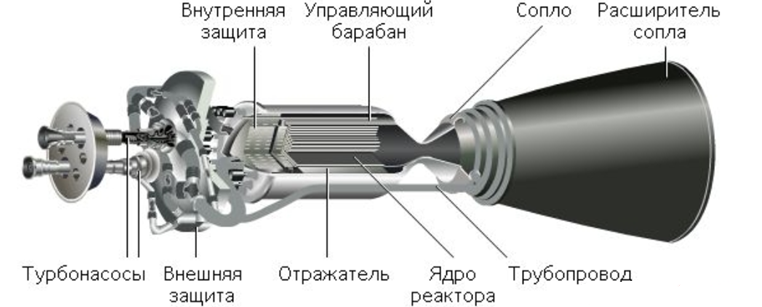
A nuclear rocket engine (YARD) is a jet engine in which the energy generated by a nuclear reaction of decay or synthesis heats the working fluid (most often hydrogen or ammonia) [3].
There are three types of YARDs by type of fuel for a reactor:
- solid phase;
- liquid phase;
- gas phase.
The most complete is the solid-phase version of the engine. The figure shows a diagram of the simplest YARD with a solid nuclear fuel reactor. The working body is located in the outer tank. With the help of a pump it is fed into the engine chamber. In the chamber, the working fluid is sprayed through nozzles and comes into contact with a fuel-generating nuclear fuel. When heated, it expands and flies out of the chamber through the nozzle at great speed.
In gas-phase NRE fuel (for example, uranium) and the working fluid is in a gaseous state (in the form of plasma) and is kept in the working zone by an electromagnetic field. The uranium plasma heated to tens of thousands of degrees transfers heat to the working fluid (for example, hydrogen), which, in turn, being heated to high temperatures and forms a jet stream.
According to the type of nuclear reaction, a radioisotope rocket engine, a thermonuclear rocket engine, and the nuclear engine itself are distinguished (nuclear fission energy is used).
An interesting option is also a pulsed YARD - it is proposed to use a nuclear charge as an energy source (fuel). Such installations can be of internal and external types.
The main advantages of YARD are:- high specific impulse;
- significant energy storage;
- compactness of the propulsion system;
- the possibility of obtaining a very large thrust - tens, hundreds and thousands of tons in a vacuum.
The main disadvantage is the high radiation hazard of the propulsion system:- penetrating radiation fluxes (gamma radiation, neutrons) during nuclear reactions;
- removal of highly radioactive compounds of uranium and its alloys;
- the flow of radioactive gases from the working fluid.
Nuclear power plant
Considering that any reliable information about N-EDU from publications, including from scientific articles, cannot be obtained, the principle of operation of such facilities is best viewed with examples of open patent materials, although containing know-how.
For example, the outstanding Russian scientist Anatoly Sazonovich Koroteev, the inventor of the patent [4], provides a technical solution for the composition of equipment for a modern YARD.
Next, I cite part of this patent document literally and without comment.
The essence of the proposed technical solution is illustrated by the scheme shown in the drawing. The nuclear power plant operating in the propulsion and energy mode contains an electric propulsion system (EPA) (for example, two electric propulsion engines 1 and 2 with the corresponding supply systems 3 and 4 are shown in the diagram, reactor installation 5, turbine 6, compressor 7, generator 8, heat exchanger-heat exchanger 9, vortex tube Ranka-Hilsch 10, cooler emitter 11. In this case, the turbine 6, the compressor 7 and the generator 8 are combined into a single unit - the turbogenerator-compressor. The NPP is equipped with pipelines 12 of the working fluid and electrical lines 13 connecting the generator 8 and the propulsion system. The heat exchanger-heat exchanger 9 has the so-called high-temperature 14 and low-temperature 15 inputs of the working fluid, as well as high-temperature 16 and low-temperature 17 outputs of the working fluid.
The output of the reactor unit 5 is connected to the turbine inlet 6, the output of the turbine 6 is connected to the high-temperature inlet 14 of the heat exchanger-heat exchanger 9. The low-temperature outlet 15 of the heat exchanger-heat exchanger 9 is connected to the entrance to the Ranka-Hilsch vortex tube 10. The Vortex Ranka-Hilsch tube 10 has two outputs one of which (via the “hot” working fluid) is connected to the cooler emitter 11, and the other (via the “cold” working fluid) is connected to the compressor 7 inlet. The output of the cooler-emitter 11 is also connected to the compressor 7 inlet. the spring 7 is connected to the low-temperature 15 entrance to the heat exchanger-heat exchanger 9. The high-temperature output 16 of the heat exchanger-heat exchanger 9 is connected to the entrance to the reactor installation 5. Thus, the main elements of the nuclear power unit are interconnected by a single circuit of the working fluid.
YAEDU works as follows. Heated in the reactor unit 5, the working fluid is directed to the turbine 6, which ensures the operation of the compressor 7 and the generator 8 of the turbogenerator-compressor. The generator 8 generates electrical energy, which is directed along electric lines 13 to electric propulsion engines 1 and 2 and their supply systems 3 and 4, ensuring their operation. After exiting the turbine 6, the working fluid is directed through the high-temperature inlet 14 to the heat exchanger-heat exchanger 9, where the working fluid is partially cooled.
Then, from the low-temperature exit 17 of the heat exchanger-heat exchanger 9, the working fluid is directed to the Vranka-Hilsch vortex tube 10, inside of which the working fluid flow is divided into “hot” and “cold” components. The "hot" part of the working fluid then goes to the cooler-radiator 11, where this part of the working fluid is effectively cooled. "Cold" part of the working fluid should be at the entrance to the compressor 7, there should also be after cooling a part of the working fluid leaving the cooler-emitter 11.
Compressor 7 delivers the cooled working fluid to the heat exchanger-heat exchanger 9 through the low-temperature inlet 15. This cooled working fluid in the heat exchanger-heat exchanger 9 provides partial cooling of the counter flow of the working fluid entering the heat exchanger-heat exchanger 9 from the turbine 6 through the high-temperature inlet 14. Further, partially heated working fluid (due to heat exchange with a counter-flow of the working fluid from the turbine 6) from the heat exchanger-heat exchanger 9 through high-temperature output 16 again enters the reactor oh installation 5, the cycle repeats again.
Thus, a single working body located in a closed circuit ensures continuous operation of the NEDA, and the use of the Ranque-Hilsch vortex tube in the NPSU structure in accordance with the claimed technical solution provides an improvement in the weight and size characteristics of the NEDU, increases its reliability, simplifies its design scheme and makes it possible to increase the efficiency of the NUEL as a whole.
References:
1. A
rocket that nobody knew about.2.
RD-0410.3.
Nuclear rocket engines.4.
RU 2522971