Competently and in time to choose features for development and not to lose money - this is about the art of prioritization. How to find the assessment criteria necessary for your product, grow strategic indicators, offer customers even more value, adjust all internal processes in a team and achieve other visual indicators using high-quality prioritization?
This article is based on the report “What's next? Or the art of prioritization, ”which I spoke on June 26 at the
BDS conference
. Marketing .
In the report, I talked about how we prioritize features in
Hygger.io , a project management system for product teams.
Before proceeding to the description of our process, I want to briefly recall why prioritization is so important.
Why not to prioritize without prioritization?
“Product management” means deciding what we are doing for the product, and then its implementation.
Ryan Singer, Basecamp's grocery strategy
Product management consists of three large blocks:
- User research
- Planning
- Execution
At the planning stage, we "sculpt" the image of the future product. And it is very important to use materials that will improve the performance of our product, its profitability, its UX, UI, and so on.
And we will not prevaricate - I think that many product managers are getting bored from such “modeling”. From the ability to influence how the product will be.
Distractions literally kill startups. Building for the sake of building is like suicide. Therefore, having a rigorous and honest prioritization process for developing functions is crucial for controlling attention and eliminating unnecessary.
Ben Yoscowitz, author of Lean Analytics, investor and startup mentor .
It is easy to take and spend valuable team time on developing features that nobody needs. This problem is especially relevant for startups, whose time and budget are very limited.
The one who thinks that a new feature added will immediately make people want to use the entire product is mistaken.
Joshua Porter, UX Director at HubSpot
It is worth remembering the intuition - our best "helper" who constantly "whispers" in our ear: "This feature will break all of us for sure!" .
We make such features and then we wonder why nothing has changed in the product at all.
Famous in Silicon Valley,
Marty Cagan in his book
Inspired outlined three types of product managers:
- Backlog administrator . His task is to simply carefully fold all the “Wishlist” of the CEO and not lose anything.
- Roadmap administrator who can already offer something himself, but the group of stakeholders decides anyway.
- Real product manager . Only this type can make decisions on its own. That's exactly the kind of manager that my process will come in handy. If you are a different type of manager, change jobs, because changing the mindset of the CEO is very difficult.
In the face of fierce competition and uncertainty in which both start-ups and businesses are located, it is vital to be able to carry out the correct prioritization.
Hygger Prioritization Process
Now I want to talk about the process that helps us in Hygger to choose future features and make the product better and better.
Actually, everything is simple: we set ourselves goals for 2 months, select metrics for control, collect and select ideas that can improve these metrics. Next, we carry out a lean prioritization of ideas, scoring features, and finally, we write TK on features that we have won. That's all - features are ready for development.
If all this is systematized:
- We formulate the company's goals for 2 months
- We select metrics under the purposes
- We collect and organize ideas
- We carry out continuous lead prioritization
- Doing scoring features
- Detail the features and add them to the queue.
Now more.
Formulate Goals
We have a 2 week trial in the product. We want to increase the number of companies that buy a paid subscription after trial. This is our main goal for the next 2 months. We also need to build up from our competitors, because there are about 500 project management systems on the market.
Choosing Metrics
We have a main metric and auxiliary. It is important that all these metrics are in our zone of influence.
The main metric is the conversion of trial-to-paid.
Secondary metrics:
- Conversion of visitors in registration
- Activation (aka AHA moment)
- Hold - retention 1d.
The AHA moment is the moment when the user realized the value of the product for himself or even used this value.
Each product has its own value. For example, in Tinder, this is a successful messaging; on Facebook, viewing a non-empty feed for some time.
Users who feel this value we call activated. Our task is to increase the number of such users. Facebook counted and found out that the activation is affected by the number of friends - the more friends, the more tape and the more time the user hangs in the tape and the more advertising looks.
Collect ideas
Here are the main sources of feedback for our product:
- Customer support systems (customer support: Intercom.com , Zendesk.com )
- Inspectlet.com (or Mobile AppSee.com ) - recording user sessions on video
- NPS. Every month we ask a question - How likely will you recommend us to friends or colleagues? Wootric.com , Satismeter.com . Once a month users answer this question from 1 to 10 and can also provide your comment.
- Product analytics ( Amplitude.com ) - we look through the analytics and formulate new hypotheses.
- Competitor Analysis ( Feedly.com ) - carefully read all the announcements of competitors and study their new features.
- Interviews ( Custdev.com , Temi.com , Rev.com ) - we record audio interviews and then we do not transcribe ourselves, but with the help of external services.
- A / B tests
- Reviews. Use the App Store, Google Play, Capterra.com , Appfollow.io or Appannie.com
- UX testing
- Polls
Organize ideas
Since we have a lot of feedback, we constantly clean up our grocery backlog. This helps us quickly find the right things and not be distracted by unnecessary ones.
How we structure our product backlog:
- on components (backend, frontend, API, mobile apps)
- by scope (UX, marketing, tech debts, bugs)
- We mark with flags the most strategically important
- Link insights and features to understand the relevance of features.
From the interesting note, we link all customer requests with features. For example, a feature request was received through Intercom. The support manager adds it to the board, and the product manager further links these requests to the features. Thus, we estimate how much this or that feature will be in demand.
Making Lean Prioritization
Periodically, as new ideas accumulate, we evaluate them using the Lean Prioritization method. This is a simple 2x2 matrix with two axes - complexity and value:
- Value - what contribution the feature gives to the product.
- Difficulty - labor costs for the implementation of features.
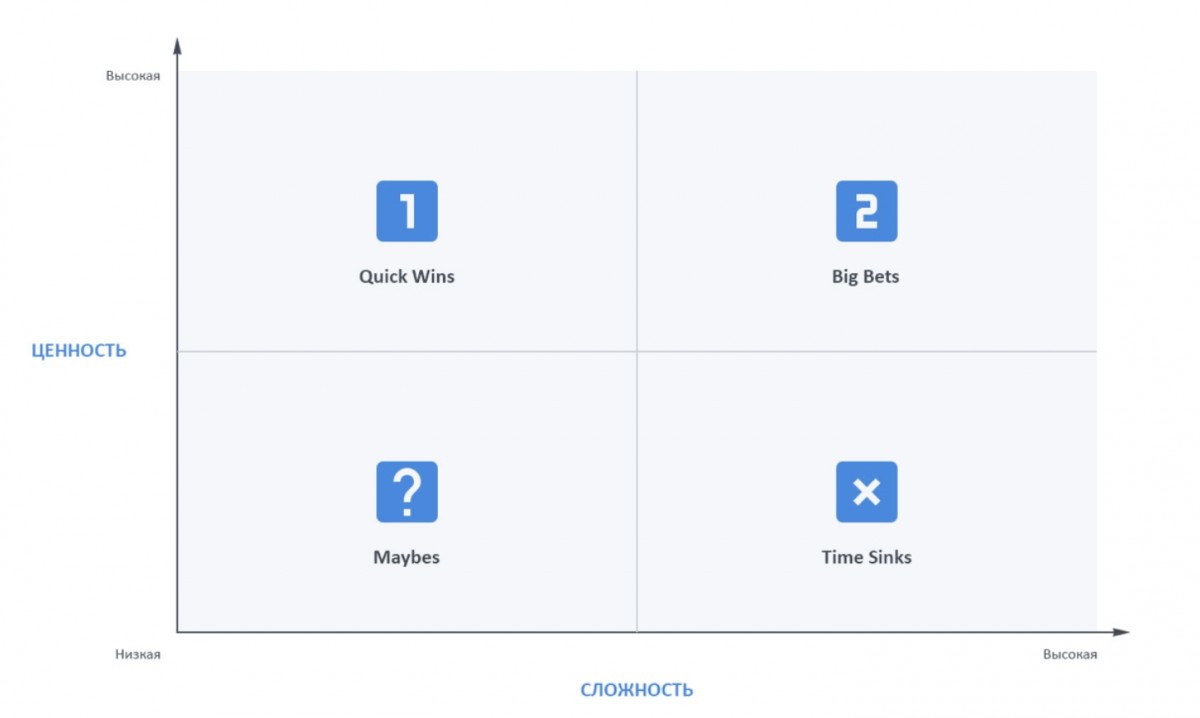
- We take to work first Quick Wins - features that give great value, but which can be very quickly washed down.
- Next - Big Bets . These are features that can bring more value, but they are difficult to implement.
- Then - Maybes - tasks and functions that do not bring great value, but are easily realized. They may well be implemented later.
- And finally, Time Sinks . These features now do not need priority and due attention.
In each product, Value means something different. In our case, Value get features that:
1) Improve trial-to-paid conversion metrics (metrics movers)
2) Help to attract new users (aha-moment)
These are features that help us hook new users during onboarding. But do not forget about the fact that most users "fall off" on the second day. For example, in SaaS an excellent indicator for day 1 retention is 15%. That is, 85% of people simply go on the second day. Therefore, you should think about features that will be seen by as many new users as possible as close as possible to the moment of registration.
3) Help to keep old users
Customers bought a subscription and are now asking to make some feature. We do not "rush" blindly to do everything. We accumulate statistics on each feature - how many customers asked for it. And then we make the most popular features.
4) Add value to the product and keep us away from competitors.
There are about 500 project management systems on the market. To survive and succeed, we need to do something completely new, preferably a multiple of life-enhancing users or a multiple of cost-cutting.
Here we are looking for features that can give us a competitive advantage, that is, they will create a reason for competitors' customers to come to us. This competitive advantage should be unique, difficult to repeat and, ideally, not reproducible.
Planning poker
We use
Planning Poker to evaluate ideas:
- going group
- the facilitator takes the idea and the group discusses it out loud to come to a common denominator and understanding
- each participant evaluates the idea on the Fibonacci scale and puts the card face-up
- then the lead reveals all the cards
- people who set max and min explain their decision
- further the team is trying to find a consensus
- in the end, we come to a common denominator and then proceed to the next idea.
Prioritization techniques
Daniel Zacarias collected
20 prioritization techniques into the collection and grouped them into two properties — external / internal and quantitative / qualitative.
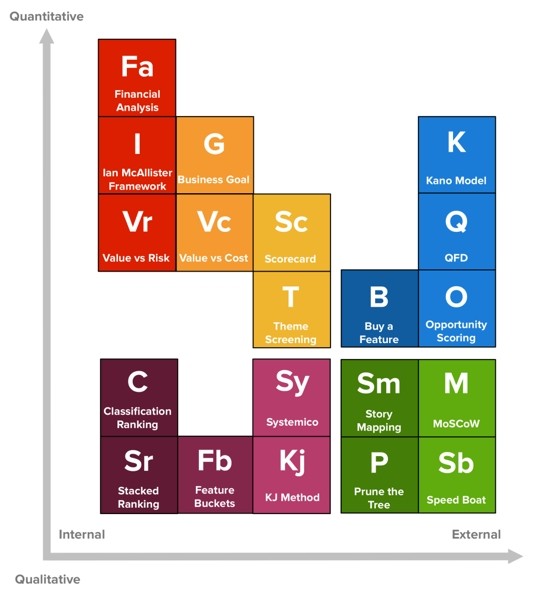
An example of external quantitative technology is
the Kano model , where we give a questionnaire to users. An example of internal quantitative technology is Lean Prioritization (or Value vs Cost). I described this method above.
Scoring feature
We're not scoring all the features, but only those that have won in Lean Prioritization, because scoring is a time-consuming operation.
We evaluate each feature by the selected criteria, on a scale from 0 to 10. Next, we multiply these values by weights and get some final numerical rating, which allows us to compare features with each other.

Scoring criteria
Here are various criteria you can use for scoring:
- target metrics
- increases profit
- helps to attract new customers
- helps to keep old customers
- user value
- strategic value - will not give now, but then it will help to do something
- is it possible to solve the problem through the existing functionality
- strong innovation
- have many competitors
- need many users
- how often is needed
- development time and cost
- time and cost of implementation
- confidence that will shoot
- expected by Kano
- desired by Kano
- Kano's amazing - wow-effect, value for PR
- improves the code (facilitates refinement and support)
- Pirate Metrics (AARRR)
results
So, what results did this process bring to us:
- Reduced the degree of intuition's influence on decision-making - now we are guided not by the scent of a product manager, but by visual and tangible evaluation criteria.
- "Put in place" HiPPO (highest paid person's opinion). Hippo is the opinion of the person with the highest salary. As a rule, it is the boss who can enjoy his authority in making decisions.
- We are systematically growing strategic indicators: we have begun to move in the right direction, which leads us to our bright goal.
- We supply our customers with more value per unit of time. Maximizing Value is our goal. We want our customers to receive the most important things first.
- The team understands WHY we make specific features. Thanks to the scoring and criteria, it is easy to explain to all curious colleagues why we took this or that feature into work.
- Minor ideas are hidden and do not make your eyes hurt - still 80% of ideas will never be realized. We have reduced the time costs for backing grooming - now the manager simply does not see minor features - they are hidden from him.
And how do you choose features for development?