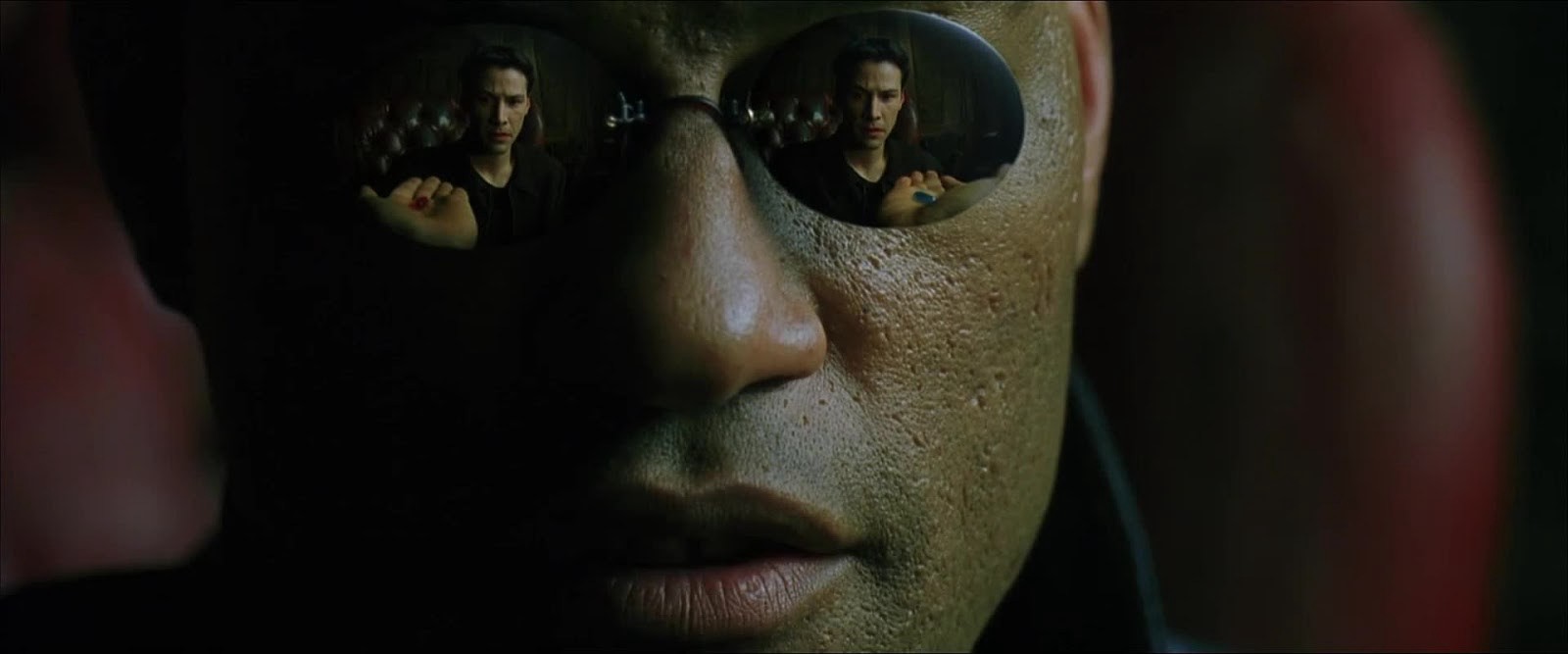
 “If you choose a blue pill, you wake up in your bed in the morning and believe that it was all just a bad dream.” Source: original article.
As before, they just did not call what we now understand by the word "cyberpunk". In the eighties, the pioneers of the genre used the terms everyone who is in that much: "fundamental outright science fiction", "outlaw technomaniac", "wave of the eighties", "neuromancy". For a time, “cyberpunk” was even equated with “a company with mirror glasses.” This happened mostly not so much because of the book “Mirror Points: An Anthology of Cyberpunk,” a collection of short stories edited by Bruce Stirling, but rather due to the Movement - a group consisting of Stirling himself, John Shirley, Lewis Scheiner, Pat Cadigan, Rudi Rücker and William Gibson, often shown in public in his favorite accessory: mirrored sunglasses.
In the preface to the collection, Sterling suggested that "opaque glass hides the expression of the eyes and thus does not make it 'normal' to understand that there is someone crazy and most likely very dangerous." According to him, it is possible to distinguish those who "look into the distance over their heads, blatantly gazing at the sun, dreamers, rockers, bikers, policemen, everyone who puts himself above the law." Thus, “chrome-shiny or dull-black” glasses, on which Sterling repeatedly focused attention on the “style icon”, actually became a cult subject for the Movement, and later began to flicker regularly in various works as a literary stamp.
At about the same time, Sterling and Lewis Shiner wrote "Mozart in mirror glasses" (1986), about a time traveler who went to the past to change the course of events in the future. But in order to get what he wants, the main character has to trade in goods from his chronological segment (or, as the text says, “original time”), while interacting with historical characters like Marie-Antoinette or Wolfgang Amadeus Mozart, who in the end became addicted to jeans, leather jackets and the notorious glasses.
The plot, playing on anachronisms, presents the reader of fifteen-year-old Mozart with all his tricky habits as a stereotypical
millennial — like the young we see today from the eighties. A clever, ambitious and loving rally, the Austrian composer is well aware of his own genius and that his symphonies are to enter the pantheon of the best works in music history, but this is not enough for a flighty teenager: Mozart is eager for the future, where he is cool as a rock star and all the world is reflected in the glasses of his glasses.
Her eyes are like mirrors
Two years earlier, in 1984, William Gibson and his "Neuromant" presented us with Molly Millions, a heroine equipped with eye implants. At first, the protagonist named Case considers them to be mirror glasses, but he soon realizes that "silver lenses seem to grow straight out of smooth, white skin of her cheekbones, framed with dark, coarsely and unevenly trimmed hair." Yes, Molly permanently sealed her eye sockets with multispectral visors, and therefore at the same time modified the tear ducts - they were redirected to the oral cavity so that you could not shed tears, but simply spit or swallow. Damn, how cool is this girl!
The reflection in the mirror symbolizes the concept of “virtuality”.
The strong and bright image of the mercenary inspired many other people, for example, the
Information Society group in the album Hack (1990) dedicated the song
“Mirror Glasses” to her. Later, in 1995, the film “Johnny Mnemonic” was released, an adaptation of the Gibson story of the same name, in which, unfortunately, the public's favorite turned into “Jane” and lost its famous implants, but several years later we again see it in the Wachowski brothers trilogy, breathing new forces into cyberpunk to jump into the next century. Yes, yes, Trinity, one of the central characters of the “Matrix” trilogy - rethought Molly.
The minimalistic design of costumes in the “Matrix” gave rise to a whole direction of style, when leather, latex, black and long raincoats became associated with severity and ruthlessness, and of course, it was not enough without sunglasses. And the cult became not so much the dark ones like those of Neo and Trinity, but rounded mirrored ones that adorn Morpheus’s face. Paying tribute to the fashion of the eighties on the “futuristic”, “The Matrix” presented her own vision, bringing together both the habit of being ready to dress in all black and
rivethead's prikody.
Liquid metal
In the seventies, two unusual models appeared in one of the new lines of the Ray-Ban company:
Ray-Ban Vagabond and
Ray-Ban Stateside, with a plastic frame and two types of lenses - the standard G-15 and the mirror G-31. To achieve a mirror effect, manufacturers have tried many different materials, including such as nickel, titanium and ... chrome, metal, which eventually turned into another cyberpunk totem.
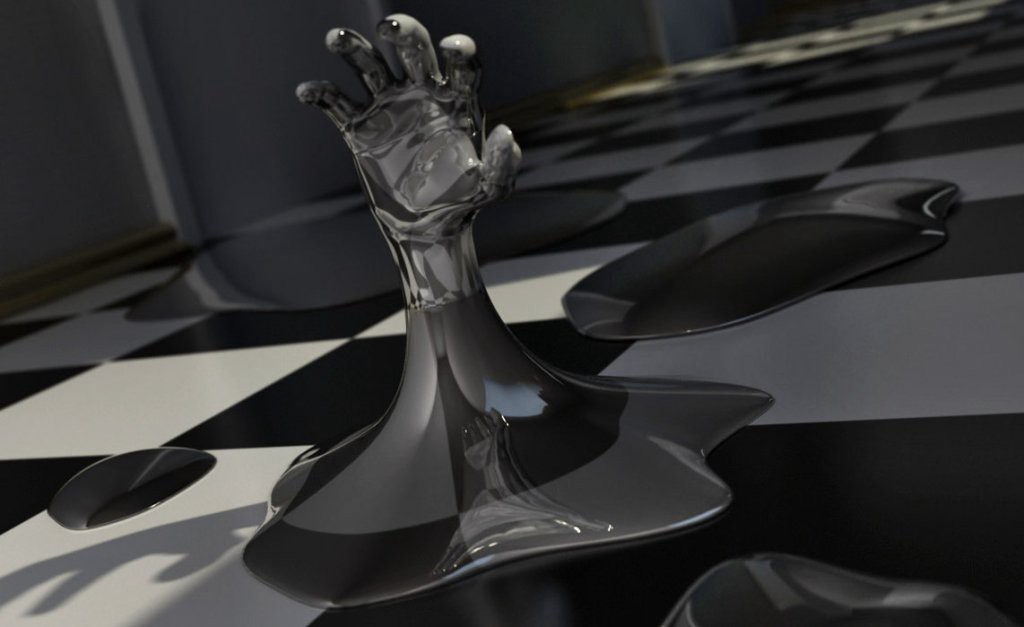 The Hand of the Liquid Metal Terminator from Terminator 2: Judgment Day (1991). Source: original article.
This attachment is easy to see, for example, from the 1982 Burning Chrome of the same Gibson’s pen, a book where cyberpunk and chrome coexist side by side
starting with the cover itself . We saw a similar thing in Terminator, especially in the second film, where the T-1000 model could easily change shape and turn into a puddle of liquid metal.
If we return to “The Matrix”, we see that in many scenes the franchise often uses shiny surfaces, simultaneously with the reflection distorting the appearance of the characters - this is a reference to Jean Baudrillard, in the fake book
“Simulacra and Simulation” of which Neo
keeps money and floppy disks illegal software . In the role of "chrome" here are the rear-view mirrors, and glasses, and even a layer of sparkling slush that covers Chosen after he took the red pill. But this is not so much a matter of pure style, as a consistent expression of the same idea. After all, we are reminded every time: the environment is virtual, not only a fake reflection - the whole world around is fiction.
Looking through the mirror
One of the fan theories about the Matrix states that mirror glasses can only be worn by those who have reached a higher level of insight. The idea is interesting because both the agents and the crew of the Nebuchadnezzar are well aware of the illusiveness of the Matrix and use this knowledge for their own purposes, and therefore belong to those who have achieved "enlightenment." However, alas, no one, except Morpheus, wears such glasses, so most likely this item is not an indicator of status for him, but rather, a reflection of some kind of life philosophy.
It seems to me that Neo, shot in the reflection of Morpheus's glasses, represents a virtual image of the savior of mankind - that germ of the Chosen, which has not yet matured. An explanation is required here - the word “virtual” did not always mean “unreal”. When the
scholastics first proposed the term “virtualitas” in the 14th century, they put the meaning of “manifestation” into it, and thus “virtuality” meant the same thing as “potential”. And as long as the founder of semiotics,
Charles Sanders Pierce, did not sharply criticize this term, the scholastics believed that “every seed is a“ virtual ”, that is, a“ potential ”tree. Therefore, in relation to the film, the viewer through the reflection looks at the “virtual” Neo through the eyes of Morpheus - and with it sees the future Chosen One.
For Agent Smith, the service program that maintains order in the Matrix, his glasses are both an indicator of the level of information access to the Matrix, and a mask hiding the face and appearance. Opaque glass eliminates the eyes as a "mirror of the soul", hiding all the emotions of the character, and thus he appears more like a soulless mechanism. But as soon as Smith loses this accessory, we finally see a look full of hatred and horror — it turns out that despite his artificial nature, he is just as vulnerable as a man — and this moment symbolizes the beginning of the overthrow of the power of the machines.
Sunglasses as a cyborg prosthesis
Given the habit of Stirling to constantly mention how awesome they looked with their glasses in the Movement, it is not surprising that later this subject flashed in various cyberpunk works - we recall at least Bato's eye implants from “Phantom in armor” (1995) or Adam's augmentation Jensen from the Deus Ex franchise. And gradually, points as an element of style in cyberpunk became not only “add steepness”, but also be used in a practical way.
After all, once, in addition to
the Cyborg Manifesto by Donna Harawei (1985),
Robbie Davis-Floyd in 1998 generally stated that “now we are all cyborgs” simply because we use computer equipment, hearing aids or wear glasses. Now it sounds funny, but in those years, cyborgization was primarily perceived as a way to use the achievements of science and technology to facilitate the daily lives of people with disabilities, but as a culture associated exclusively with modernizing themselves for the sake of going beyond biological limits, they began to perceive “cyborgs” much later.
 "I never asked for this." Source: original article.
David-Floyd, for example, has repeatedly cited Steven Hawking as an example of a person who is still seriously engaged in astrophysics and leads a very active life for someone who has become a symbiosis of man and machine. Professor
Catherine Woodward , in her book “Social Sciences: Huge Problems” (2003), wrote that instead of constantly opposing mechanics and living organisms, “we could get significant benefits by not limiting ourselves to the“ naturalness = body = relationship ”with one side and "machine = artificial" on the other. " Woodward believes that cyborgization will finally make humankind manageable and that "uniting people with machines will allow us to learn control and cooperation." And for the same reason, the aforementioned Harawei in every way avoided attempts to endow the technique with hostility, stating nonetheless that our world will ultimately depend on the machines: “They are part of us, but we are part of them.”
In the end, if we summarize all such opinions, the trend for mirrored glasses was, albeit quite accidentally, the first step towards adopting cyborgs as part of our daily life.
And before the era comes, where people without functional deficiencies are modernizing themselves with implants just to become better, it will take a lot of work to first help those for whom prostheses are a vital necessity. Fortunately, both science-fiction writers and other creative personalities - such as the Deus Ex development team, which recently
created the prosthesis in the style of Adam Jensen's hands - are already working to make cyborgs finally become commonplace for us.
"Take the red - you will enter the Wonderland." Source: original article.First published in Versions in 2016.