SIIG MiniSys S286 - in general, an ordinary 286th computer, but too unusual layout. The author under the nickname Glitch read about it back in 1998 on the
museum page
of outdated computers , and in October last year I was able to purchase it.
On it is badly visible, that at transportation the smoky overlay for LEDs of indication of a supply and activity of a hard disk is slightly damaged. But this does not affect the performance, in contrast to the leaked nickel-cadmium battery. The author cleaned the places on the board that got electrolyte, washed them and dried them with hot air. Instead of a battery, he connected a compartment for the 1 / 2AA element, in which he placed a 3.6-volt Tadiran lithium thionyl chloride cell, although he could have a compartment for two ordinary 1.5-volt zinc-manganese AAA cells. Neither can be charged, instead of switching on in series with the diode compartment, Glitch found a charging circuit and disconnected it.

The battery was charged through a 470-ohm SMD resistor located on the back of the motherboard. After soldering this resistor, the voltage at the battery connection pads disappeared, which means that the compartment can be connected. The author stuck it with double-sided tape to the drive so that the element could be quickly changed.

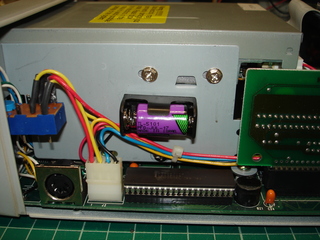
RTC and CMOS started working again, and the
Seagate ST351A / X hard drive was OK. This is a very reliable drive, and the author had to deal with them when they were not outdated and in subsequent years. But Glitch decided not to leave it there, because the suffix A / X means compatibility with the original XTA controllers, as well as ATA-IDE controllers. XTA is the
original XT-IDE controller , the 8-bit IDE interface that the drive was originally designed to work with, and not the
modern XT-IDE controller . Some older computers, including the popular Tandy 1000 model line, have controllers designed for just such hard drives. So, the ST351A / X will move to any machine with the XTA, and here a 128 Mbyte industrial PQI Flash module will work.
The purpose of a single 16-bit ISA slot is obvious - for an Ethernet card. The author chose Intel EtherExpress 8/16, as he has several such cards with 10baseT, 10baseT / thinnet and AUI interfaces. The board fits easily into the volume reserved for it.


The
Crynwr driver and the
mTCP package, which includes many tools for DOS, including the IRC, HTTP, FTP, Telnet, SNTP, etc. clients The author also installed
the Arachne browser , somewhat surprised that they worked on it in 2013, because he himself used this browser in the late nineties on the 386th. Today, very few resources are compatible with this browser, among them is the site of the Glitch itself ...
... as well as a
retro version of Hackaday , displaying randomly selected posts from different years, the set of which changes periodically.


Well, that this computer was found. Glitch plans to work on it with DOS utilities that access parallel and serial ports. He also sometimes lets the machine on the irc.slashnet.org IRC server into the #vc channel.