
Seven years ago, with the help of
the Zenit-3F rocket with the
Fregat-FB booster into orbit, the
RadioAstron telescope was perhaps the most productive scientific project in the modern history of Russian cosmonautics. The history of this project and the process of its work will be discussed today.
Project history
In
1965, three Soviet scientists (Kardashev, Matveyenko, and Sholomitsky) proposed the concept of
radio interferometry with super-long bases, in which radio telescopes spaced apart over long distances allow the joint work to obtain a resolution corresponding to the distance between them. The first experiments in this direction were carried out with ground-based telescopes, but only if one of the telescopes was put into space, this method would allow getting really amazing results. The first “breakdown of the pen” in this direction was the radio observatory
KRT-10, which worked at the Salyut station from July to August 1979. It was the first time when such experiments were carried out together with the 70-meter ground telescope
RT-70 . And in
1980, it was decided to build 6 space radio telescopes, among which was the Spektr-R project, later named RadioAstron.
In the early 1990s, the first test samples of the radio telescope receivers were created, in 1994 the first mirror tests were carried out, and
in 2003, the Pushchino Radio Astronomy Observatory conducted the first tests of the prototype space telescope, which, due to launch delays, was subsequently significantly modified . Tests of the final version of RadioAstron were conducted in early 2011.
 Transportation telescope at Baikonur
The design of the apparatus and scientific objectives
RadioAstron
has a mass of 3660 kg, with 2600 kg of them being scientific equipment, of which, in turn, 1500 kg falls on the main 10-meter antenna. The device was developed in the NPO. Lavochkin
based on the Navigator service module, one of the first examples of the use of which was the
Electro-L series of hydrometeorological satellites. The body of the device is an 8-sided prism, on the outside of which the service equipment is installed, an antenna is installed on top, consisting of a central 3-meter integral block and 27 petals, opening after being removed, and on the bottom side there is a mount to the overclocking block. Work at a wavelength of about 1 cm imposed great demands on the accuracy of manufacturing and the telescope opening mechanism, since the telescope's surface must have an order of magnitude greater accuracy than the wavelength at which it operates. That is, the 10-meter mirror during its work should not deviate from the ideal form of more than about 1 mm.
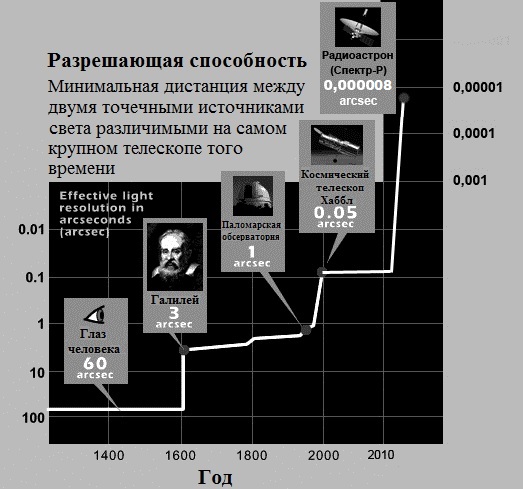
Communication with the radio telescope is carried out through a 1.5-meter directional X-band antenna operating at a frequency of 17 GHz. The transfer rate of scientific data is 144 Mbps. RadioAstronom is managed through space communication stations in
Bear Lake and
Ussuriysk , and the transfer of scientific data via the 22-meter
radio antenna of the Pushchino radio astronomy observatory and through a 43-meter antenna in Green Bank, USA (she joined the project in September 2013 year, allowing doubling the observational time). To power the telescope, solar batteries with a power of 2608 W are installed on it, while the work of utility systems requires 980 W, and the work of scientific equipment (which works for about
20% of the whole time) requires another 1200 W, so the power supply system has a considerable margin. The radio telescope has 4 receivers operating at temperatures
from -175 to -125 ºC and having the following characteristics:
| Wavelength, cm | 92 | 18 | 6.2 | 1.2-1.6 |
|---|
| Frequency, MHz | 316-332 | 1636-1692 | 4804-4860 | 18372-25132 |
| Resolution, microseconds | 540 | 106 | 37 | 7 |
* The resolution of the Hubble Space Telescope and the best ground-based telescopes for comparison is about 100 microseconds.In order to ensure the operation of such an accurate instrument, very precise determination of the parameters of its orbit was required: in order for RadioAstron to work at its shortest wavelengths, its speed must be determined with an accuracy of more than 2 cm / s, acceleration - with an accuracy of no less 10
-7 m / s
2, and to know the distance with an accuracy of less than 500 m used for this purpose as five methods:. radiometric method for measuring speed and distance, Doppler velocity determination method and interferometric methods is carried out s via terrestrial radio antennas; as well as laser location and optical methods for determining the position of background stars.
Among the project
participants from the Russian side, in addition to the head enterprise NPO them. Lavochkina was attended by ASC LPI, OKB Mars, ZAO Vremya Ch and many other organizations. In addition, there is a significant
international participation in the project: since the receiver amplifier was manufactured in India at a wavelength of 92 cm, 18 cm - in Australia, and 1.3 cm - in the USA. Since the telescope passes through the radiation belts during its work, it was also decided to install the plasma-magnetic complex Plasma-F for measuring plasma parameters and individual charged particles of radiation belts and the interplanetary medium with a record time resolution (up to 32 microseconds ), as well as intended for the study of turbulence in these environments.

The Plasma-F complex consists of two instruments: a fast solar wind monitor (BMSV) designed to measure the energy distribution, the flux vector, the transport velocity, temperature and ion concentration (IKI RAS, the Institute of Atmospheric Physics of the
Academy of Sciences of the Czech Republic and
Charles University in Prague , Czech Republic); and monitor energetic ion fluxes (MEP) designed to register ions with energies from 30 keV to 3 MeV and electrons with energies of 30-350 keV (it was created at the Institute of Experimental Physics
SAN in Košice, Slovakia). The project also required a very high accuracy of the time resolution, so a pair of domestic atomic clocks with an accuracy of 10
-14 were installed on the telescope (this corresponds to the clock leaving for 1 second in more than 3 million years). In addition, a rubidium watch made in Switzerland was used as a backup system for determining the time. In total, scientists
from 20 countries worked on the creation of scientific equipment for RadioAstron (the full list of participants can be found
here ).
Since this telescope received the highest resolution among all modern telescopes, its main scientific program included observation of the most compact objects in the Universe: neutron stars,
quasars and interstellar gas clouds (the so-called
megamasers re-emit light in the radio band according to the principle of a laser).
Launch and Scientific Results
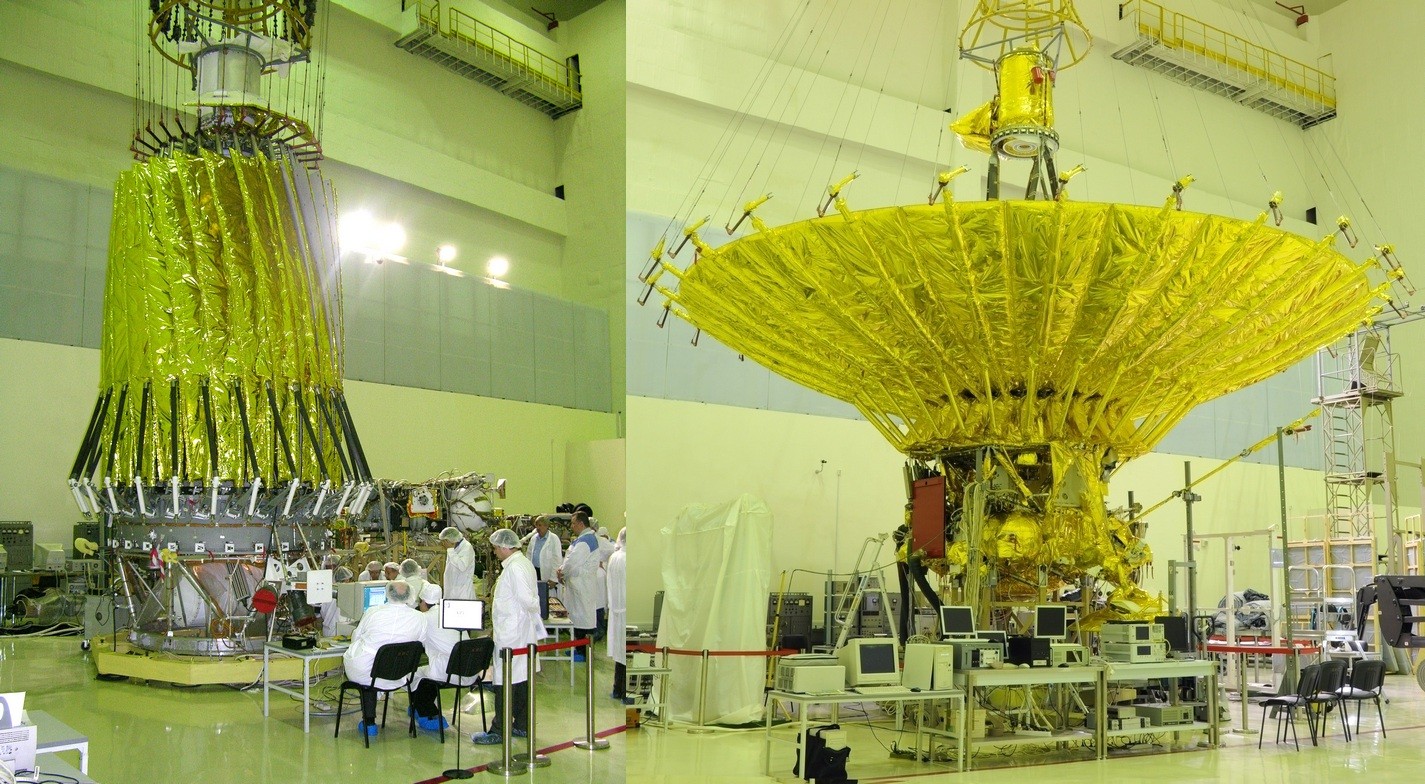 Telescope in folded and unfolded position during ground tests Telescope disclosure process
The telescope was launched on July 18, 2011 at 6.31 Moscow time into a highly elliptical orbit of 600x330,000 km with an inclination of 51.3º and a period of about 9 days (during operation, its orbit gradually changes under the influence of the gravity of the moon). The telescope was unfolded on the night of
July 22-23, and it should have taken only 10 minutes, but the antenna's petals did not stand up on the fixtures from the first attempt, so it was decided to unfold the telescope so that the disclosure mechanism evenly warmed under the sun's rays, after which the second attempt held on the afternoon of the 23rd ended well. On July 25, the first activation of the Plasma-F complex was made. The main atomic clock also did not work as it should from the first time, so it was decided to immediately switch to standby. The “first light” the telescope saw on September 27, 2011 - these were observations of the remnant supernova Cassiopea A and Jupiter, and already on November 14 and 15 the first scientific data were obtained: the B0531 + 21 pulsar was shot (located in the Crab Nebula), quasars 0016 + 0731 and 0212 + 735; as well as the maser W3 (OH) in the constellation Cassiopeia.
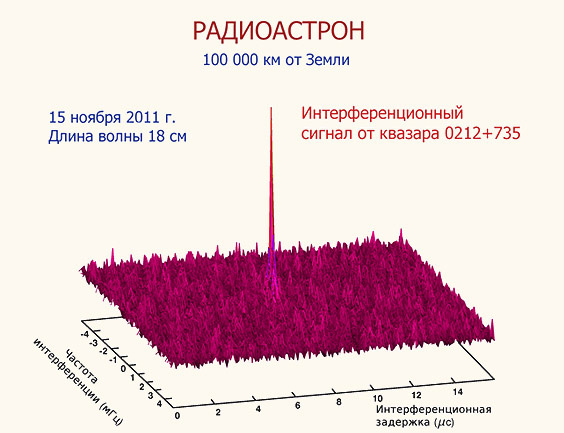 The first observations ...
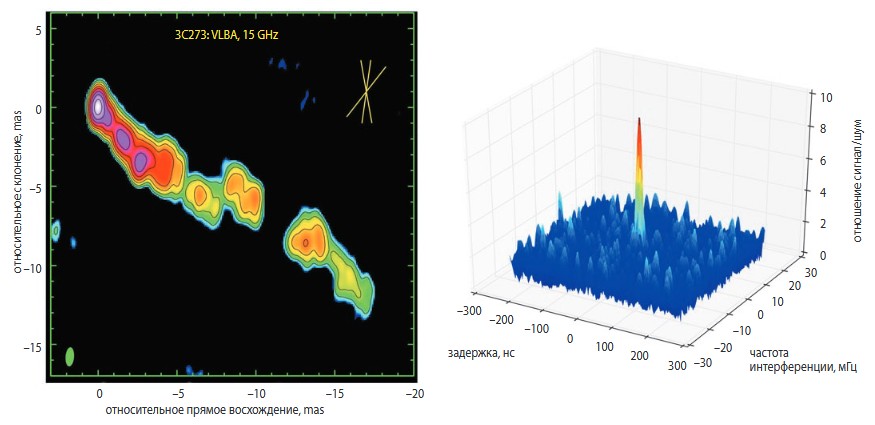 ... and the first scientific results.
Tests of three longer wavelength receivers passed without complications, but with the start of work in the shortest 1.3 cm range, we had to wait
about six months for reasons beyond RadioAstron's reasons: unlike the space telescope, its ground-based counterparts have the ability to work in this range strongly depended on the weather (more precisely, on the content of water vapor in the atmosphere). And besides, the atomic clock of the American telescope, which was working at that moment in tandem with Radio Astron, also failed, so the first scientific results at this wavelength were obtained only from
6 attempts and already in conjunction with another telescope - the 100-meter radio telescope in
Effelsberg , Germany. But despite this, the apparatus started the early scientific program
on December 10 , and the main program started in
July 2013 , while at the end of 2012 the telescope switched to accepting applications through
an open competition (in the first stage only scientists from the participating countries could participate ) in which once a year anyone can take part. As a result, all received applications are evaluated by the board of scientists, after which
Nikolay Kardashev himself (who was at the origin of this project) decides which applications will be accepted into the work.
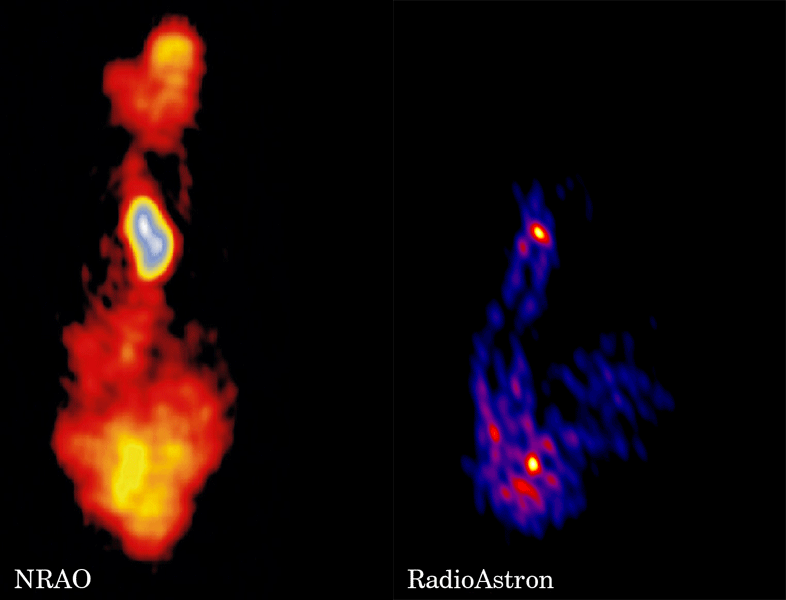 Snapshot of the nucleus of the galaxy NGC 1275 "Perseus A" when viewed from the ground-based telescope and RadioAstron.
During the first year of operation, more than 100 radio-interferometric observations were made, with a total duration of more than 200 hours. Among the objects observed were 29 quasars, 9 pulsars, and 6 masers. At the beginning, the observations were carried out with a small base (the distance between the telescopes) and gradually increased to the maximum: in the observations of the quasar 3C273 of
January 2013, the first world record of angular resolution was set up on the basis of 8.1 Earth diameter (it was 27 microseconds of arc) distance to the object, its dimensions were limited "from the top" with a diameter of 0.3 light years). Already in 2013, long before the project reached its full capacity, it was found that the
brightness temperature of a substance in quasar jets in the radio range is 10 trillion degrees - which
is 100 times higher than the limit of the theories that existed at that time. On February 14, 2014, RadioAstron obtained an original result that was not related to science in any way - it was listed in the Guinness Book of Records as the world's largest orbital telescope.
Further, the maximum resolution of the telescope also continued to increase: in 2015, RadioAstron during the observation of the
OJ287 quasar (the second black hole by mass, currently opened by a man with a mass of 18 billion solar masses, around which another black hole rotates with a mass of “only” 140 million Mass of the Sun) received a resolution of 14 microseconds. In 2016, this record was improved to
11 microseconds when observing a cloud of water vapor with a radius of 80 distances from Earth to the Sun at a distance of 20 million light years (these observations revealed that such
“space masers” are very compact) .
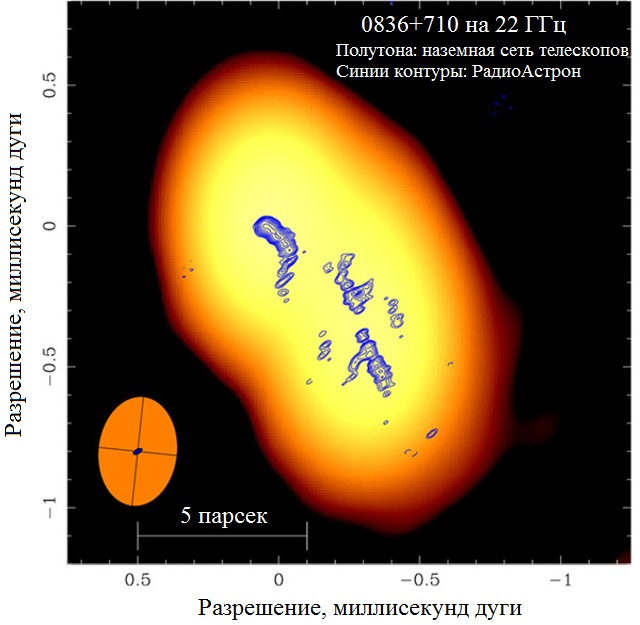 Another example of comparing the resolutions of the ground network of telescopes and Radio Astrone is a survey of blazar 0836 + 710.
RadioAstron also made an unexpected discovery for everyone: they discovered the so-called
substructural dispersion , which consists in the fact that interstellar gas refracts the radio emission of compact structures, creating several separate “spots” in place of one signal source. This effect allows us to investigate not only the object observed in radio waves, but also the medium between us. However, this phenomenon also creates problems, as it prevents the observed object from being seen in all its details. Therefore, in 2016, scientists have developed a method of
image restoration , which should allow to see radio sources of radiation behind the clouds of interstellar gas and dust, such as the supermassive black hole located in the center of our Galaxy and the surrounding stars.
The telescope is also used in many other scientific studies that require observations with particularly high resolution, and its atomic clocks were used in an
experiment to confirm the general theory of relativity in terms of the time dilation effect of a moving object. At the moment, the data have not yet been processed, but the theory has already been confirmed with an accuracy of 0.01% (this corresponds to the accuracy of the
Gravity Probe A mission), and after processing all the data, the accuracy of the experiment should increase by an order of magnitude. In 2017, the device
ran out of neutral hydrogen to operate its atomic clocks, so the scientists had to switch to two other synchronization methods: the rubidium frequency standard and the “closed loop” —the second mode turned out to be more accurate, while it consists of sending to the telescope 7 GHz reference signal, which is sent back at 8 GHz. Due to this, it is possible to compensate for the delay in signal transmission due to the heterogeneity of the atmosphere and to achieve the necessary accuracy in the synchronization of observations. The experiment to test the theory of relativity by that time had already been completed, so that the loss of atomic clocks does not threaten the scientific program of the telescope.
 One of the recent images of RadioAstron: the core of the active galaxy BL are Lizards located 900 million sv. years from us
In total, over the first 5 years of work,
more than 5 thousand scientific experiments were conducted. In the course of the last scientific program to work with the device,
more than 100 applications were received and about 500 observations were made, which shows that the interest of scientists in the project is not decreasing, but even increasing. During the scientific program of 2017–2018, during the observations of the megamaser NGC 4258, together with the telescope in Medichina (Italy), RadioAstron
managed to closely approach its theoretical limit of characteristics, having reached a resolution of 8 microseconds of arc. Accepting applications for the next observation program (which is already the sixth in a row) began on December 22, 2017 and lasted as standard for a month (
here is the list of research won in the competition). During the work of "RadioAstron" in the interferometric observations with him managed to participate observatories from almost all over the world: Europe, USA, China, Japan, Australia, South Africa and even South Korea.
And now we come to the questions of the direct participant of the project:
Alexander Plavin, a researcher at the laboratory of extragalactic radio astronomy at the FIAN Astro-Cosmic Center and the laboratory for research of relativistic objects at MIPT, answers the questions.Which observatories and countries participate in interferometric observations with RadioAstron?Practically all large telescopes in the world participated at least once in observations with RadioAstron, up to ~ 40 telescopes simultaneously. Many countries and several continents: Europe / Asia, America, Africa, Australia. Among the regular observers are, for example, the largest in the world rotatable antenna with a diameter of 100 meters - in Green Bank (USA) and Effelsberg (Germany), as well as many other telescopes.
Are foreign computing powers used to process and compare the results of interferometric observations?In general, the main computing resources are the correlation of data from ground stations and from the space telescope. On a regular basis, the correlation is carried out in Moscow (ASC LPI) and in Bonn (Max-Planck-Institut für Radioastronomie), and various software is used - special testing was conducted to agree on the results. Also, despite the fact that this is not exactly “computing power”, the contribution of the Green Bank Observatory (USA) is important. A special receiving and transmitting equipment was installed there that allows you to connect with the satellite even when it is not visible from the territory of Russia (a communications station in Pushchino, near Moscow).
How much does the number of applications for working with a telescope exceed its capabilities? How time is distributed between domestic and foreign scientific organizations?Despite the fact that some long-term programs of review and monitoring of active galactic nuclei have recently been completed, the volume of applications filed still exceeds the capabilities of the telescope. When allocating time between applications, it does not matter which country the main author is from: just like for most telescopes around the world, time is provided according to an open general competition. This allows most scientifically efficient use of the time of such expensive instruments than if there were country restrictions. Also, generally speaking, applications from “domestic and foreign organizations” cannot be separated, as they are submitted from an arbitrary group of authors, which usually includes scientists from different countries.
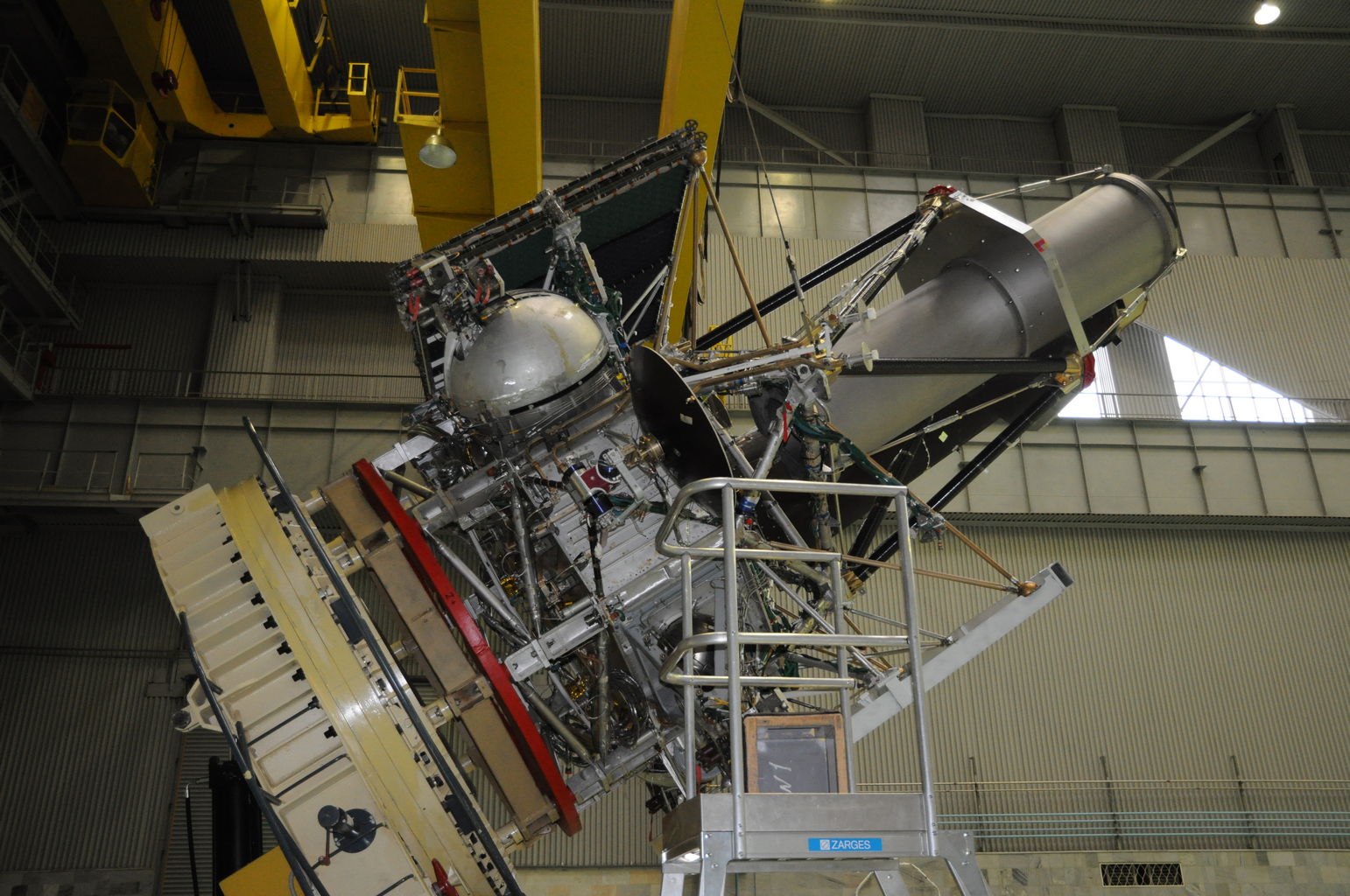 Spectrum-WG (Spectrum-X-Gamma)The launch of Millimetron was postponed for a long time due to the Roskosmos budget cut, but recently they again started talking about resuming construction of the third RT-70 radio telescope on the Suff plateau - are there any other radio astronomy projects in development now?
Relatively soon, in the spring of 2019, it is planned to launch the next satellite of the Spectrum series - Spektr-RG, i.e. Roentgen-Gamma. It will be located near the Lagrange point L2, that is, much further than RadioAstron: almost 2 million km compared to 350 thousand km. Long-term observations are planned in the X-ray range to obtain a map of the entire sky, as well as a detailed observation of individual galaxies.
 Spectrum-M (Millimetron)Once again, thanks to Alexander Plavin for the answers provided, and here you can see his previous interview.
Future of the project
The telescope's mission was extended several times: until
July 2015 , the
end of 2018 and now (after the next correction of the orbit, which occurred
on July 17, 2017, required for RadioAstron not to go into the Earth's shadow for several hours and not be without power supply of solar batteries) the work of the apparatus was extended until the
end of 2019 .
“We are optimistic about the prospects for the project after this period and expect that it will be extended further, since this is a truly unique device with unique capabilities,” the laboratory’s FIAN Astro-Cosmic Center reported on the next orbit correction.
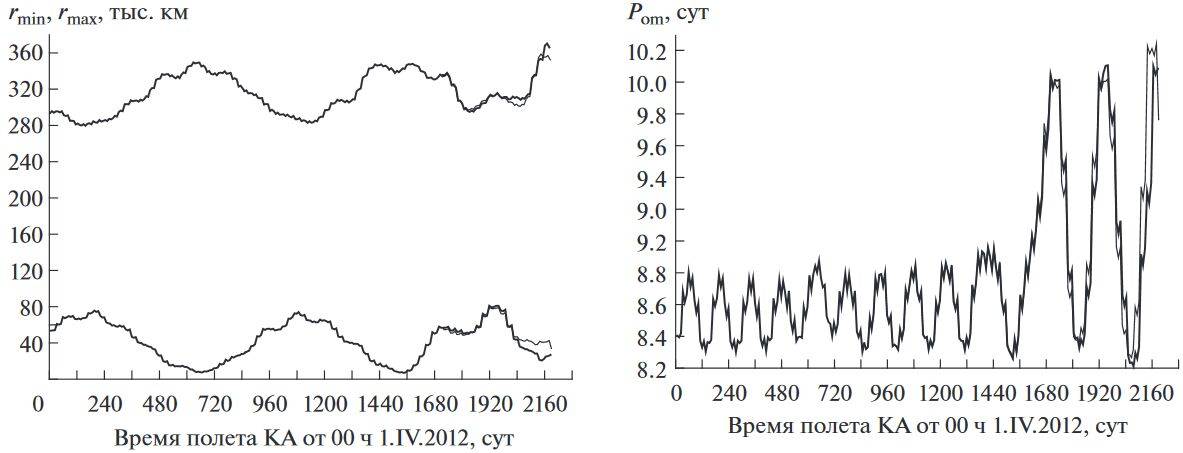 The evolution of the orbit of a telescope under the action of the moon
Due to the high precision of launching into orbit, RadioAstron has no problems with the fuel supply: for the first year of its operation, only
10.3 kg of 287 kg of the total mass of fuel on board was spent. In addition, a specially selected orbit for the apparatus allows significant fuel savings: orbit corrections were carried out only in March 2012 and
July 2017 . So even now, after 7 years, he still has
70% of the initial mass of fuel, so the operation time of RadioAstron is now limited only by the duration of its onboard systems, which are difficult to predict.
Links
Bulletin NPO them. Lavochkina dedicated to the
3rd anniversary and
5th anniversary of the project
Open research
baseTheme dedicated to RadioAstron on the site "News of Astronautics"
Here are reports on the operation of the telescope
And here are the scientific publications of the project