Maersk Launcher in a hike in the Clarion-Clipperton Zone in the PacificWhen the 300-foot Maersk Launcher moored in San Diego early Monday morning, the catch, consisting of hard black clumps collected from the ocean floor, was unloaded from it. These lumps are not stones, but naturally formed metal
nodules , which someday can give us cobalt, manganese and nickel - not to mention rare-earth metals.
Global demand for metals grows with the increase in the number of batteries for electric vehicles and wind turbines, next-generation technologies and weapon systems. The bottom of the ocean is the main goal of these developments. Of course, raising these nodules the size of potatoes from the bottom somewhere in a remote part of the Pacific Ocean, and then transporting them to a processing factory, the metal that mines them, is not an easy task at all.
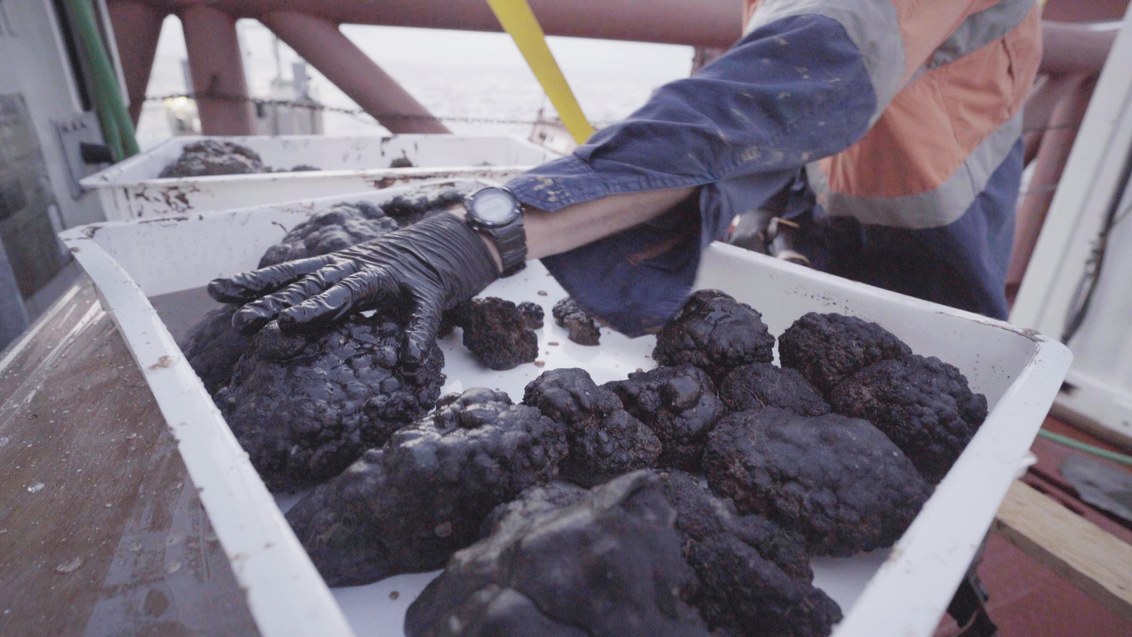 What is mined at the bottom of the ocean: bottom polymetallic nodules mined at the site for which NORI has obtained a license
But the leaders of the Canadian mining company
DeepGreen Metals and its divisions of NORI (Nauru Ocean Resources Inc.) believe that they have figured out how to collect nodules without destroying the habitat of deep-sea residents - and at the same time make a profit from it.
“Nature has created these resources that are rich in metals that are necessary for our future,” says Deep Green director Gerard Barron, a former Australian advertising technology entrepreneur who invested $ 8 million of his own money in an underwater mining enterprise. “This is a new oil. Our nodules contain everything you need to create batteries for electric vehicles. ”
A team of more than 70 technicians, researchers and scientists have just completed a seven-week journey aboard the Maersk Launcher to
the Clarion-Clipperton zone , a tidbit of the Pacific Ocean floor covering 4.4 million square meters. km between Hawaii and Mexico, abundant in world reserves of these nodules.
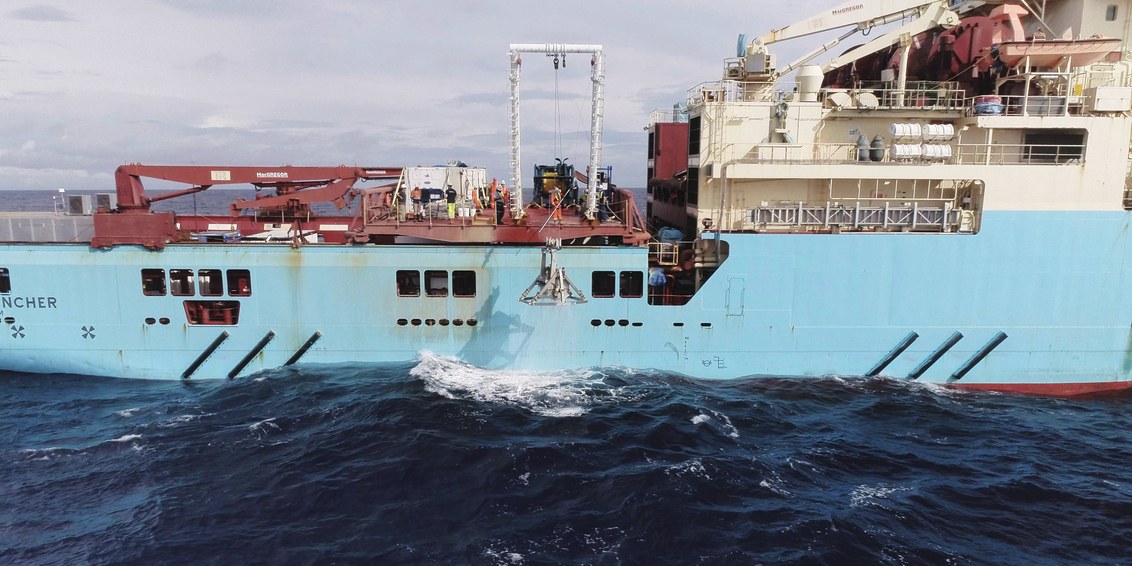 The use of the device for collecting polymetallic modules from the seabed
Researchers aboard ship-borne shipments dumped box-shaped devices to a depth of 3,600 meters in order to collect test nodules, as well as to lift sediments and dirt from the bottom. Mobile autonomous underwater vehicles filmed the entire operation on video, provided orientation and collected data on water quality. This mission was the first of several to determine the environmental impact of mining operations that DeepGreen must conduct in order to obtain final approval from the International Seabed Authority. The Authority controls the exploration and production of minerals in the Clipperton zone and distributed development rights to various countries, including the partner DeepGreen, the island state of
Nauru .
DeepGreen says it wants to behave appropriately with the inhabitants of the seabed. She recently hired Greg Stone, a former chief scientist at the
International Society for the Conservation of Nature , to help plan mining operations with the least impact on the seabed and its inhabitants. “For the first time, we prepare and plan the whole operation in advance, before launching production,” says Stone. He notes that DeepGreen also relies on data from previous attempts to collect these mineral-rich sediments. This includes the infamous vessel “
Glomar Explorer ”, which participated in the project, which turned out to be a
secret attempt by the CIA to get from the bottom of a sunken Soviet submarine.
“We rely on decades of law development and years of research to properly describe the seabed and build deep-sea models to understand the flow of animals living there and the changes taking place,” says Stone.

DeepGreen says it is developing a caterpillar sweeper, which it hopes to try out in the next year or two. The idea is to send an autonomous device across the seabed at a distance of only a few centimeters. The assembly will be connected to the pump hose, which will suck the nodules to the surface, to the ship. Stone says that a closed system will return cold ocean water to the bottom, rather than dumping it on a warm surface to minimize environmental impact.
They also want to ensure that they do not break the bottom structure. This can be done by collecting minerals in a staggered manner. The idea is to leave areas untouched by the assembly, in which inhabitants of the seabed may hide or move. “We will apply the most successful methods and principles, compile a catalog of all the creatures living there to find out if there will be any unique features in our way,” says Stone. “If we find a plot with a unique view living on several hundred square kilometers or meters, we will miss it.” If we find that all the bottom is about the same, we will make sure that the work will be carried out in a patchwork manner so as not to destroy the entire territory ”.
Despite all the precautions, some oceanologists believe that it is very difficult to leave the bottom untouched.
Andrea Koszinski-Fritzsche from Jacobs University in Bremen is studying the possible impact of mining on various deep-water habitats. She compares the impact of mining with a fishing trawl, which stretch along the bottom. “The effect on bottom sediments is quite comparable, but recovery will be slower than from trawlers,” says Kosinsky-Fritzsche. “There is much more food on the continental shelf than in a deep-sea ecosystem.” She says that scientists still do not know much about the diversity and populations of worms, clams, fish and other inhabitants of the dark world of the seabed.
Of course, such uncertainties do not stop mining companies such as DeepGreen or London-based Seabed Resources, a division of Lockheed-Martin, who are planning various tests and pilot projects before starting full-scale operations in the coming years. In April,
Japanese researchers announced the discovery of huge reserves of similar black nodules containing rare earth metals, which should be enough for many hundreds of years, just 1,900 km southeast of Tokyo. Apparently, the slow race for underwater wealth just got a good charge of speed.