The first workable technology of photography was called
daguerotype . This is a
photographic process , the basis of which is the photosensitivity of silver iodide. The technology enjoyed a well-deserved popularity for about 20 years, until it was replaced by more practical (and most importantly - cheap) processes.
Current images are different in appearance from daguerreotypes. The latter are more like a reflection in the mirror. The reason for this is that the "picture" was obtained using a mixture of silver and mercury. She was called a memory mirror. Depending on the angle of inclination of the plate to the light source, the daguerreotype may look both positive and negative. The disadvantage of this type of image acquisition was the fragility of the result.
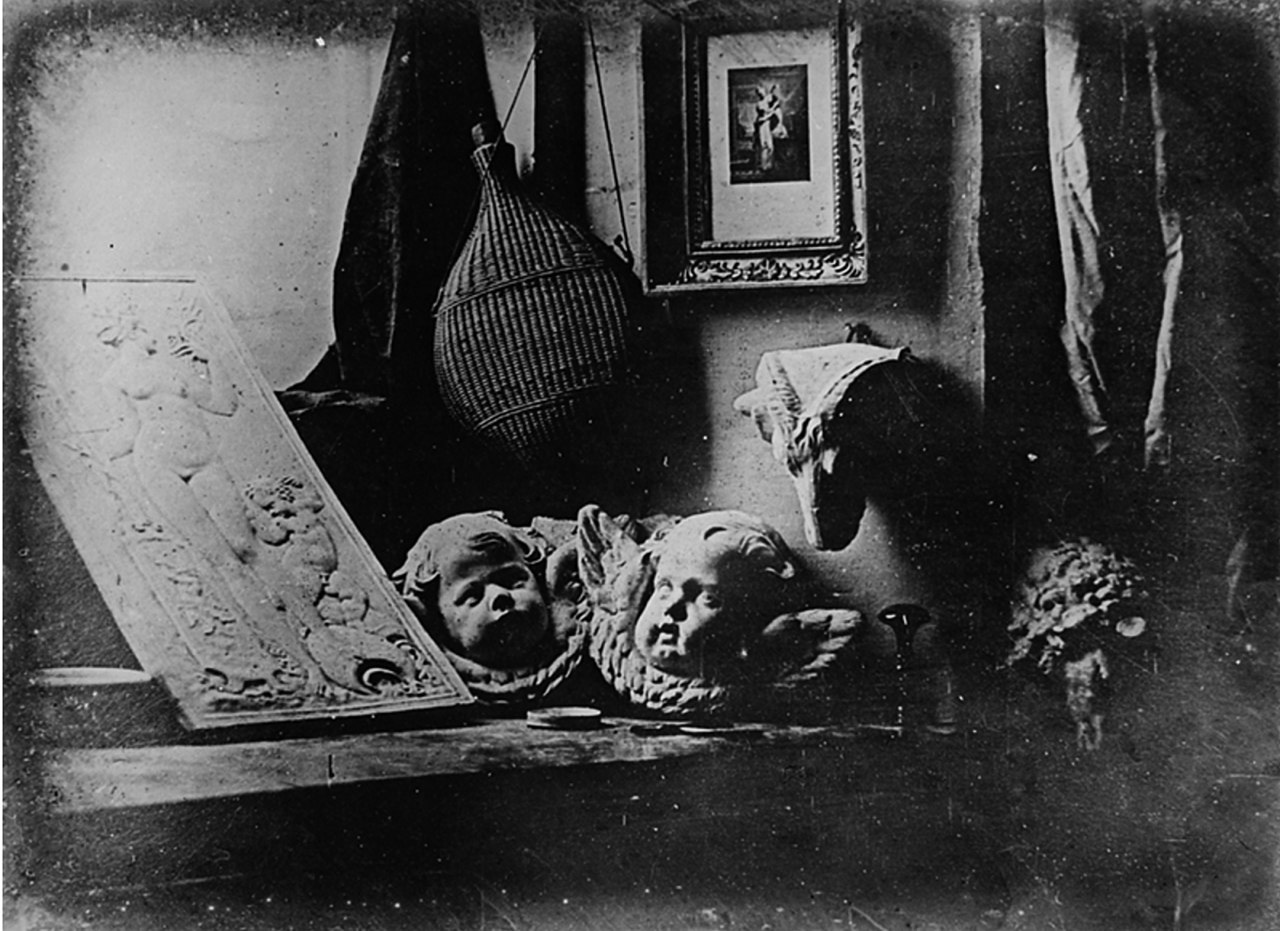 Daguerreotype, created by technology inventor Louis Daguerre in 1837
By the way, in order for a clear image to appear on the amalgam plate, the sunlight would have to interact with this plate for three minutes. So lovers of photography had to be patient - after all, neither changing the position, nor even the facial expression was impossible. Otherwise, the image would turn out to be unsuccessful, “blurred”.
Not many daguerreotypes that were made in the 19th century have survived to this day. The overwhelming majority have lost their original appearance and it is absolutely impossible to understand what is depicted on them. But scientists from Eastern University
were able to restore the "pictures" of almost a century and a half ago.
Recently, Nature published an article with the results of the work of "photoarchaeologists". It described the work of scientists who were able to recover two images from daguerreotypes that were stored in the National Gallery of Canada. They were made in 1850, but over time the image on them disappeared. But they managed to recover with the help of modern technology. As it turned out, one “photo” depicts a woman, another - a man.
“Searching for images on daguerreotypes is a bit like a hunt,”
said Madalena Kozachuk, a representative of a research team that began restoring images from the 19th century. The most interesting thing is that the daguerreotypes were unreadable - there was already no image on the plate. His, if I may say so, ate time. But modern experts have learned to restore the past. They have restored the images and are now planning to expand their experience to more daguerreotypes.
The man and the woman who are depicted in the restored “pictures” are unknown - after all these years, all memories of who they were at one time disappeared.
It is worth noting that the technology of restoring daguerreotypes is not as simple as it might seem. The scientists in question began to work on the creation of a method of image restoration three years ago. And only now they have achieved success.
The first results scientists have received last year, while conducting research at the Canadian Light Source (CLS). At the same time, a report on the work on daguerreotypes was published. The report, in particular, described what is happening with the amalgam and the image obtained with it.
Scanning X-ray fluorescence was used to restore the “picture” to determine how mercury is distributed on the daguerreotype plates. The x-ray beam diameter was 10x10 microns when scanning. This is about 7 times smaller than the diameter of a human hair. Scanning each daguerreotype took about eight hours.
It was mercury that made it possible to understand what the original “picture” was. “Mercury is the main element of the process that allowed to restore the image. Despite the fact that the surface is degraded, and very much so, the particles of mercury remained intact. Analyzing their location, we can get an image in excellent quality, ”says one of the project team members.
As mentioned above, only two records have now been restored. In fact, quite a lot of daguerreotypes are stored in large and not very large libraries. In many cases, no one remembers what was depicted on them. And what scientists are doing now is more like archeology than working with images.
The work of scientists is very interesting - both in historical terms and in purely technological. Something like this until now did only "audio archaeologists", as already
published materials on Habré.